
Guides
Creatine Monohydrate: What It Is, Who It Suits and How to Take It

Oct
Creatine monohydrate is the supplement form of creatine, a compound your muscles draw on during short, hard efforts. It suits adults who train at high intensity: sprints, intervals, heavy sets, racquet and team sports. The simplest way to take it is 3g of creatine every day, stirred into water or a shake, at whatever time you will reliably remember. A loading phase is optional; turning up daily matters more than the clock.
In this guide
What is creatine?
Your body makes creatine, and you also get some from food, mainly meat and fish. The International Society of Sports Nutrition (ISSN) position stand notes that about 95% of it is held in skeletal muscle, that roughly half of the daily need normally comes from the diet, and that the body has to replace around 1–3g a day to keep its usual stores topped up.
In muscle, creatine acts as a quick reserve for the first few seconds of an all-out effort. That is why it is talked about in the context of repeated sprints and lifting rather than long, steady exercise. Creatine monohydrate is simply creatine bound to one water molecule. It is the form used in most of the research, and the form NeoLife uses.
What can creatine actually do?
In Great Britain only authorised wording can be used about what a nutrient does. For creatine, the retained health claims regulation allows this: “Creatine increases physical performance in successive bursts of short-term, high intensity exercise.” The condition is a daily intake of 3g of creatine, and the claim is aimed at adults doing high-intensity exercise.
A second authorised claim covers older adults: daily creatine can enhance the effect of resistance training on muscle strength in adults over 55. That one comes with strict conditions too – 3g a day alongside resistance training at 65–75% of your one-repetition maximum, at least three times a week, for several weeks.
Notice what neither claim says. Creatine does not replace the training, and it is not described as doing anything for walking, yoga or steady jogging. If your exercise is mostly gentle or long and even-paced, there is little reason to take it.
Who does creatine suit, and who should skip it?
- Likely to suit: adults doing gym sets, circuits, interval sessions, sprinting, or stop-start sports such as football, hockey, tennis and squash.
- Worth knowing: because meat and fish supply much of the usual intake, vegetarians have been reported to have lower muscle creatine stores, according to the ISSN paper above.
- Not suitable: NeoLife’s label rules out children, and women who are pregnant or breastfeeding.
- Check first: if you have a kidney condition, take regular medication or are under medical care, ask your GP or pharmacist before starting.
How much creatine should you take a day?
For the authorised claim, the figure is 3g of creatine daily. Labels can be confusing here, because some quote the weight of creatine monohydrate and others the weight of creatine itself. About 3.4g of the monohydrate provides 3g of creatine, so check which number a label is giving you. More is not needed to meet the claim, and NeoLife’s label asks you not to exceed its recommended daily serving.
Do you need a loading phase?
Loading means taking a large amount for a few days to fill muscle stores quickly. The ISSN position stand describes the classic approach as 5g four times a day for 5–7 days, followed by 3–5g a day. It also describes the slower alternative: 3g a day for 28 days, which raises muscle stores without the big first week.
| Approach | Daily amount | Time to fill stores | Practical notes |
|---|---|---|---|
| Loading | About 20g split into four doses for 5–7 days, then a maintenance dose | About a week | More doses to remember; short-term fluid retention of about 0.5–1 litre reported |
| Steady daily intake | 3g of creatine every day | About four weeks | One dose a day; matches the authorised claim and a single NeoLife serving |
Our honest view: unless you have a competition next week, loading buys you very little. With NeoLife Creatine specifically, the label says not to exceed the daily serving, so the steady route is the one to follow.
How to fit creatine into a real week
Creatine works by keeping muscle stores full over weeks, so the habit matters more than the hour. Some ways to make it stick:
- Pin it to something you already do. Breakfast, the first glass of water at your desk, or the shake after training all work.
- Take it on rest days too. Stores are maintained by daily intake, not just on training days.
- Mix it and drink it straight away. NeoLife’s directions are two scoops in 240ml of water or a shake, stirred well and drunk immediately.
- Drink plenty of fluid through the day, as the label advises.
- Keep the tub in sight, next to the kettle or your gym bag, not at the back of a cupboard.
- Missed a day? Just carry on. There is no need to double the next serving.
NeoLife Creatine: what is in it
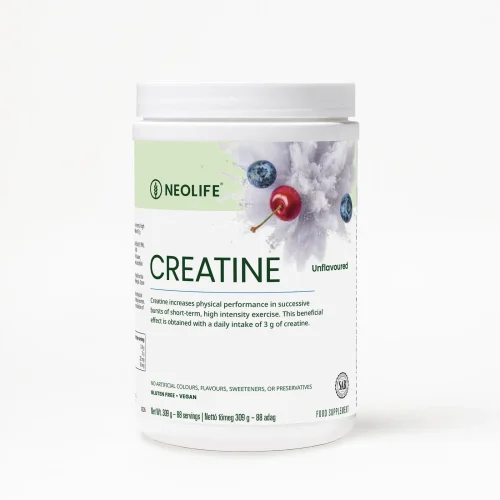
NeoLife Creatine comes as a plain, flavour-free powder. Each two-scoop (3.5g) serving gives 3.4g of creatine monohydrate, which is 3g of creatine, plus a small blend of blueberry (32mg) and tart cherry (10mg). There are 88 servings in a 309g tub. The powder is suitable for vegans, contains no gluten, and has nothing artificial added for colour, flavour, sweetness or preservation. NeoLife also says it contains none of the substances on the IOC and WADA banned lists, which matters if you compete in tested sport.
Because it has no flavour, it can go into water, a NeoLifeShake or another drink without changing the taste. The label also notes that creatine can increase body mass because of water held in the muscles. You can see related products in our energy and wellness range.
Products in this guide
Common questions
Does creatine make you put on weight?
It can make the scales go up a little, mostly because muscles hold more water when creatine stores rise. NeoLife’s label mentions this, and the ISSN paper reports short-term fluid retention during loading. This is water in the muscle, not body fat, but it is worth knowing if you weigh yourself often.
Should I take creatine before or after training?
Pick whichever you will do consistently. What counts is reaching full muscle stores through steady daily intake, so a fixed slot you never forget beats a theoretically perfect time you often miss. On rest days, take it with breakfast or another meal you never skip.
Can I mix creatine into a protein shake or coffee?
An unflavoured creatine powder can go into water, a shake or another drink. NeoLife suggests water, NeoLifeShake or one of its drink mixes, made up and drunk straight away. If you add it to anything, stir well, because creatine does not dissolve instantly and can settle at the bottom.
How long does creatine take to work?
At 3g a day, the ISSN position stand describes muscle stores rising over about 28 days, or within roughly a week if you load. The authorised claim relates to repeated short bursts of hard exercise, so any difference is most likely to show up in that kind of training rather than in everyday life.
Do vegetarians and vegans need creatine more?
Not necessarily, but because meat and fish supply much of a typical intake, vegetarians have been reported to have lower muscle stores. If you are plant-based and train hard, a vegan creatine can be a reasonable addition. If your activity is mostly gentle, there is no particular need for it.
Genuine NeoLife, delivered in the UK
Free UK delivery on orders over £150. Order online, no membership needed.
A food supplement is not a substitute for a varied, balanced diet and a healthy way of living. This guide is general information rather than medical advice. If you are pregnant, take any medication or have a health condition, check with your GP or a pharmacist before you start creatine.
Browse other targeted supplements in our targeted solutions collection.
More guides
 GuidesHow Long Do Supplements Take to Work? An Honest TimelineThere is no single answer: this guide sets out real NHS timelines, explains why feeling different is a poor test, and shows how to…
 GuidesMeal Replacement Shakes: What They Are and How to Use One SensiblyA factual look at meal replacement shakes: what goes into one, how a serving stacks up against daily protein and fibre needs, and how…
 GuidesWhen to Take Your Vitamins: Morning or Evening, With or Without Food?The clock matters less than consistency: here is when food helps, which supplements to space apart, and how to make a daily vitamin habit…